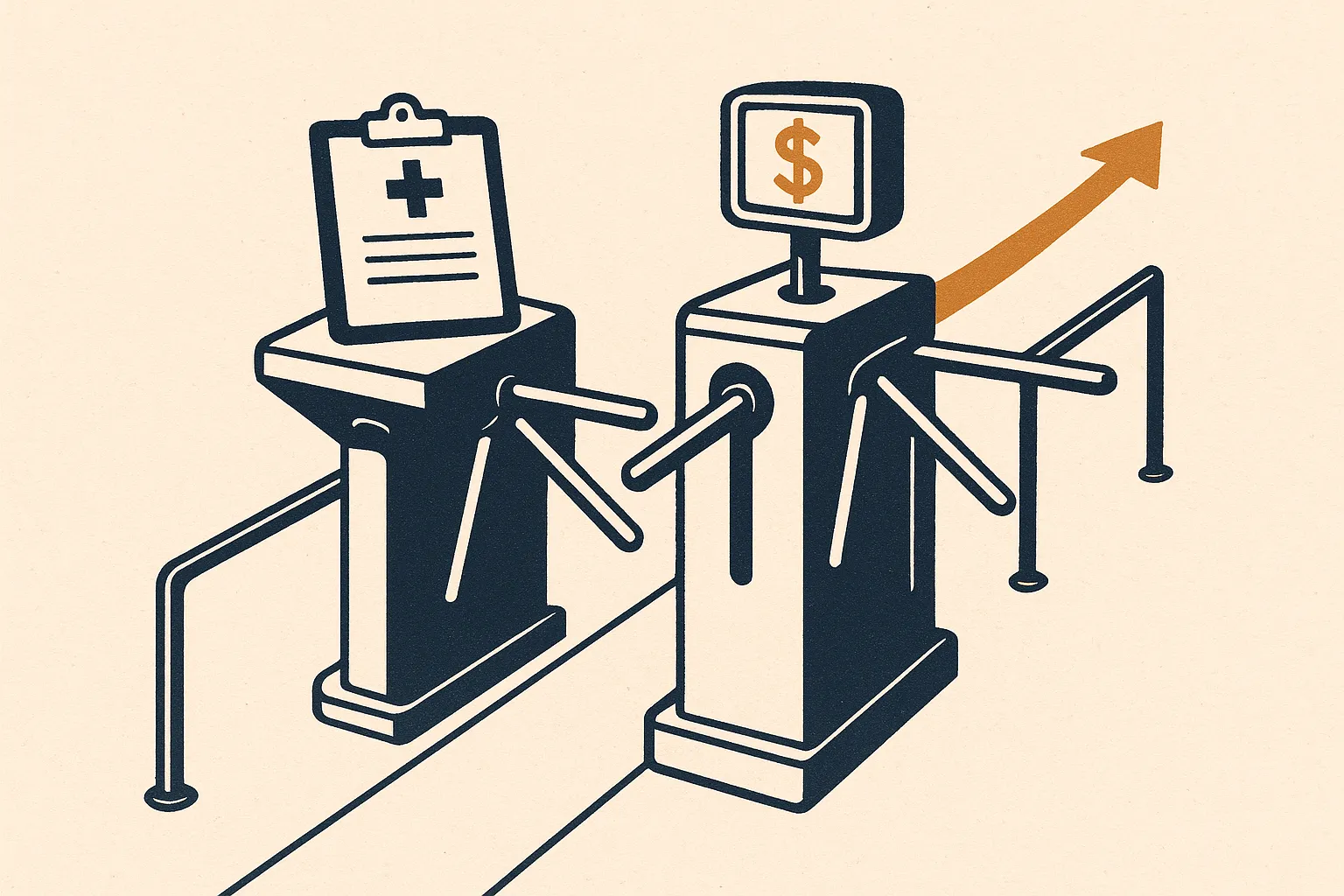
For decades, buying life insurance meant a stranger came to your kitchen at 7 a.m., drew a vial of blood, took a urine sample, wrapped a cuff around your arm, and mailed the results to an insurer who then took four to eight weeks to decide what you were worth. The paramedical exam was the toll you paid for a fair price. Then the industry figured out it could often skip the needle entirely — and it started advertising that fact as a gift to you.
It is partly a gift. It is also a trade, and the terms of that trade are rarely spelled out on the landing page. When you skip the exam, you are usually handing the carrier less information about your health, and a carrier that knows less charges more to protect itself. This file is about the size of that markup, who it makes sense for, and the fine print that survives even when the lab work doesn’t.
The three doors that skip the needle
“No medical exam” is not one product. It’s a label stretched across at least three different underwriting paths, and they are not remotely equal.
Simplified issue replaces the exam with a short health questionnaire — a handful of yes/no questions about tobacco, major diagnoses, hospitalizations, and prescriptions. No blood, no urine, sometimes an answer in minutes to days. Because the carrier is underwriting off your answers plus a few database checks rather than lab evidence, it builds a cushion into the price and caps how much it will issue.
Accelerated underwriting is the most interesting of the three and the most misunderstood. It’s a fully underwritten policy — same product, same rate classes — that uses algorithms and third-party data to decide, applicant by applicant, whether an exam is even necessary. Healthy people with clean data get waved through without a needle at rates that can match traditional term life. Anyone the model flags gets kicked back to a standard exam. The exam isn’t gone; it’s conditional.
Guaranteed issue is the far end. No health questions at all, acceptance guaranteed regardless of condition. It exists for people who cannot qualify any other way, and it prices accordingly — small face amounts, the highest cost per dollar of coverage in the market, and usually a graded death benefit that pays only a refund of premiums plus interest if you die in the first two to three years.
Same three words on the ad. Three very different deals underneath.
Why skipping the exam costs more
The logic is not a conspiracy; it’s just insurance. A carrier prices a policy on how confident it is about your mortality. Lab work and a full workup buy confidence — they can see your actual blood pressure, cholesterol, glucose, nicotine metabolites, kidney markers. Strip that away and the carrier is pricing partly on trust and partly on averages, and it will not average in your favor.
So it prices in the uncertainty. Everyone in a simplified-issue pool pays a premium built for the possibility that some applicants are sicker than they admitted. If you’re the healthy one who could have aced a blood panel, you are quietly subsidizing the people the exam would have caught. You paid extra for privacy you didn’t need.
| Path | Typical monthly premium | Common coverage cap | Time to decision |
|---|---|---|---|
| Fully underwritten (exam) | ~$30 | $1M+ | 3–6 weeks |
| Accelerated underwriting | ~$32 | Up to ~$1M–$3M | Days |
| Simplified issue | ~$45 | Often ~$500k or less | Minutes to days |
| Guaranteed issue | Highest per $1,000 | Often ~$25k | Immediate |
Read the caps column as carefully as the premium column. The second cost of skipping the exam isn’t just price — it’s ceiling. Simplified issue frequently tops out well below what a family actually needs, and guaranteed issue tops out at burial-policy size. The convenience narrows the door in two directions at once.
The premium gap between accelerated underwriting and simplified issue for the same healthy applicant can run to hundreds of dollars a year for identical coverage. Nothing about your health changed between the two quotes. The only thing that changed is how much the carrier was allowed to know — and it charged you for its own blind spot.
Who it genuinely suits — and who overpays
Honesty cuts both ways here, so let’s name both sides.
No-exam coverage is a genuinely good fit if you need coverage fast — a loan closing, a divorce decree, a business agreement with a deadline the standard four-to-eight-week timeline can’t meet. It fits if you are needle-averse or time-starved to the point that the alternative is buying nothing at all; some coverage bought this week beats perfect coverage you never get around to. And it can fit if your health history is complicated enough that a full exam would only hurt you — where a fresh panel showing a borderline number might land you a worse rate class or a decline, and answering a short questionnaire is the safer path.
You are probably overpaying if you are healthy, patient, and buying a large amount. If you could clear a blood panel without worry and your need is $750,000 of term you’ll hold for 20 years, the no-exam markup compounds into real money you handed over for a morning you didn’t want to spend. Skipping the exam to save an hour, and paying for that hour every month for two decades, is a bad trade for the person who had the least to hide.
The wrinkle: “no exam” doesn’t mean “no data”
Here is the part the marketing works hardest to blur. Skipping the physical exam does not mean the carrier is flying blind — especially on the accelerated-underwriting path. Modern no-exam underwriting routinely pulls your prescription-drug history, your motor-vehicle record, public records, and a report from the MIB — the industry’s shared database of prior applications and flagged conditions. The needle is gone. The dossier is not.
This matters for one reason above all: you cannot lie your way to a cheaper rate just because no one is drawing blood. If you check “no” on tobacco and your prescription record or a prior application says otherwise, the mismatch surfaces. And a misrepresentation on the application is exactly what lets a carrier contest a claim.
Every policy carries a contestability period — typically the first two years — during which the insurer can investigate a claim and rescind the policy for material misrepresentation on the application. No-exam policies have this too. The exam disappeared; the honesty requirement did not. An inaccurate answer on a "simple" questionnaire can void the payout your family is counting on, long after the friendly instant-approval screen.
Answer the health questions as carefully as you would answer a paramedic with a clipboard. The stakes are identical. The only thing that got easier was the logistics.
How to shop it
- Get an accelerated-underwriting quote before you settle for simplified issue.If you're healthy, accelerated underwriting can hand you traditional-underwritten pricing with no needle. Don't accept a simplified-issue markup until you've confirmed you couldn't have skipped the exam and the surcharge.
- Compare the same face amount across both paths.Ask for a no-exam quote and a fully underwritten quote for identical coverage. The dollar gap is the exact price of your convenience. Decide whether that morning is worth it with the number in front of you.
- Check the coverage cap against your actual need first.If you need $750k and the no-exam product tops out at $500k, the decision is already made — don't let the fast quote talk you into under-insuring.
- Read for a graded death benefit.On guaranteed-issue and some simplified policies, dying in the first two to three years may return only your premiums, not the face amount. Know whether the death benefit is full from day one.
- Answer every health question as if it's under oath — because effectively it is.The contestability period and shared data make accuracy non-negotiable. A cheaper rate bought with a wrong answer isn't a discount; it's a claim your beneficiaries may never collect.
- Use an independent agent to run both routes at once.A captive agent sells the no-exam product on the shelf. An independent one can price the exam path against it and tell you, honestly, which side of the trade you're on.
No-exam life insurance is a convenience, and convenience has a price tag. For someone who needs speed, hates needles, or has a health history a fresh panel would only worsen, that price is often worth paying.
For a healthy, patient buyer who wants a large policy, it usually isn't — you'd be paying a premium for a blind spot you didn't need. Get the accelerated-underwriting quote, compare it to the exam path dollar for dollar, and answer every question honestly. The exam can vanish. The truth requirement never does. For the deeper mechanics of how carriers turn your health into a number, see our file on the mortality and multiplier tables.
File 096 · Investigation · Tip line: [email protected]